
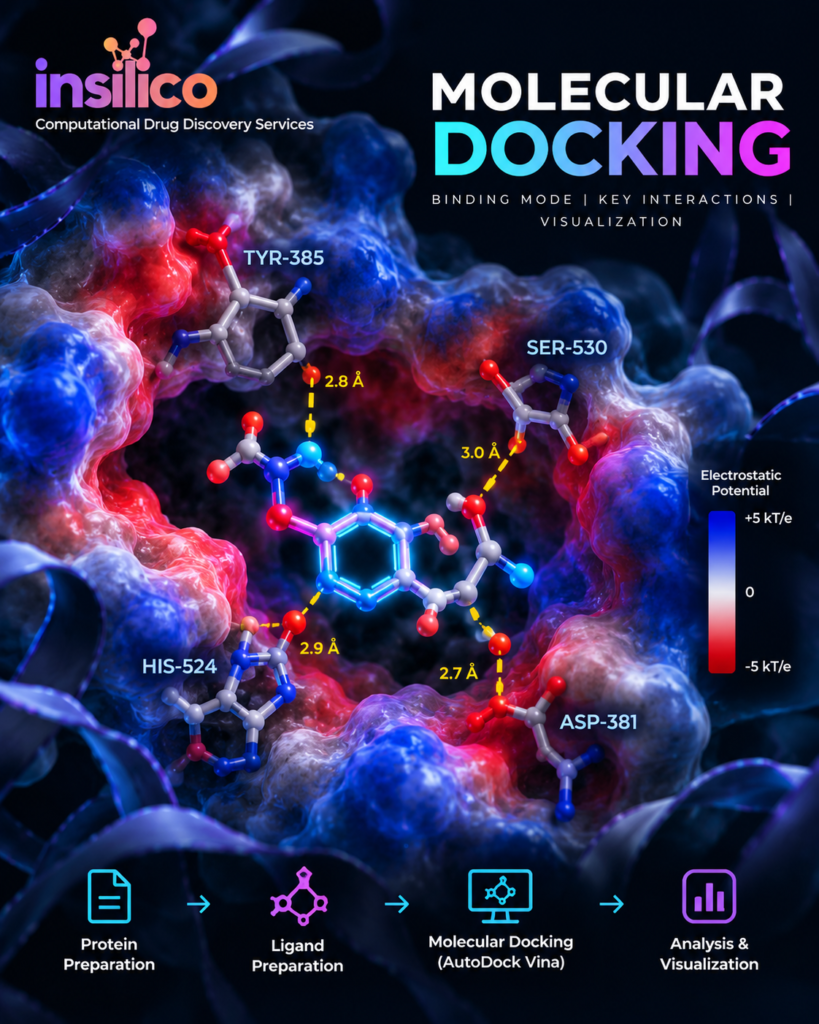
Molecular Docking Validation: Why Redocking and RMSD Matter
Molecular docking has become an essential computational technique in drug discovery, allowing researchers to predict how small molecules may interact with biological targets. However, obtaining a docking score alone is not enough to demonstrate that a docking protocol is reliable.
Before screening new compounds, researchers should consider whether the selected docking methodology can reproduce a biologically relevant binding pose. One of the most widely used approaches for evaluating this is redocking followed by Root Mean Square Deviation (RMSD) analysis.
What Is Molecular Docking Validation?
Docking validation evaluates whether a computational docking protocol can reproduce a known experimental ligand–protein interaction.
A commonly used strategy begins with a protein structure containing a co-crystallized ligand obtained from the Protein Data Bank (PDB). The ligand is removed from the binding site and then docked back into the same protein using the selected docking parameters.
The predicted pose is subsequently compared with the experimentally observed crystallographic pose.
If the docking protocol successfully reproduces a similar orientation, it provides evidence that the selected binding site, grid configuration and docking parameters are capable of generating a plausible binding mode.
What Is RMSD?
Root Mean Square Deviation measures the structural difference between two molecular conformations.
During docking validation, RMSD is commonly calculated between:
- the experimentally observed co-crystallized ligand, and
- the ligand pose generated by the docking software.
A smaller RMSD generally indicates closer agreement between the predicted and experimental orientations.
An RMSD around or below 2 Å is commonly used as a practical benchmark for successful pose reproduction, although acceptable values depend on factors such as ligand flexibility, protein structure, docking methodology and the purpose of the study.
Therefore, RMSD should not be treated as an absolute measure of docking quality. It is one component of a broader validation strategy.
Why Is Redocking Important?
Imagine screening 50 phytochemicals against a disease-associated protein and identifying several compounds with strong predicted binding affinities.
These results may look promising, but an important question remains:
Can the docking protocol reproduce a binding orientation that is already experimentally known?
Redocking helps address this question.
Without validation, parameters such as grid-box position, search space and docking configuration may generate apparently favourable scores while failing to reproduce realistic ligand orientations.
Validation therefore improves confidence in the methodology before unknown compounds are interpreted.
A Typical Redocking Workflow
A practical redocking workflow can include:
1. Obtain an Experimental Protein Structure
Select an appropriate protein structure from the Protein Data Bank, preferably containing a relevant co-crystallized ligand.
2. Separate the Native Ligand
Extract the experimentally bound ligand while preserving its original coordinates for later structural comparison.
3. Prepare the Protein and Ligand
Protein preparation may include removal of unnecessary molecules, addition of hydrogens, correction of structural issues where appropriate and assignment of required charges.
The ligand is prepared according to the requirements of the selected docking software.
4. Define the Binding Site
The docking search space is positioned around the experimentally observed ligand-binding region.
Correct grid placement is critical because an incorrectly positioned search space can invalidate subsequent docking results.
5. Redock the Native Ligand
The ligand is docked back into the protein using the same general protocol intended for subsequent compounds.
6. Overlay Experimental and Predicted Poses
The redocked pose is structurally aligned with the original crystallographic ligand.
Software such as PyMOL or other molecular-visualisation platforms can be used to inspect the overlay.
7. Calculate RMSD
RMSD is calculated between corresponding atoms of the experimental and predicted ligand poses.
The resulting value, together with visual inspection and interaction analysis, helps evaluate whether the protocol adequately reproduces the known binding mode.
Is Binding Affinity Enough?
No.
A docking score represents a computational estimate generated by a scoring function. It should not be interpreted as direct experimental evidence of binding affinity or biological activity.
A stronger docking study therefore considers multiple forms of evidence, including:
- docking scores,
- binding orientations,
- interactions with important residues,
- hydrogen bonds and hydrophobic contacts,
- comparison with reference compounds,
- redocking validation, and
- biological relevance of the selected target.
Final Thoughts
Molecular docking can generate valuable hypotheses during early-stage drug discovery, but meaningful interpretation requires more than ranking compounds by binding score.
Redocking and RMSD analysis provide a practical way to evaluate whether a docking protocol can reproduce a known experimental binding pose before it is applied to new molecules.
Combining validation with careful protein preparation, interaction analysis and biologically informed interpretation can substantially improve the quality and reproducibility of computational docking studies.
Need support with a molecular docking project?
InSilicoLogics provides molecular docking, redocking validation, protein–ligand interaction analysis and publication-ready molecular visualisations for academic and research projects.