
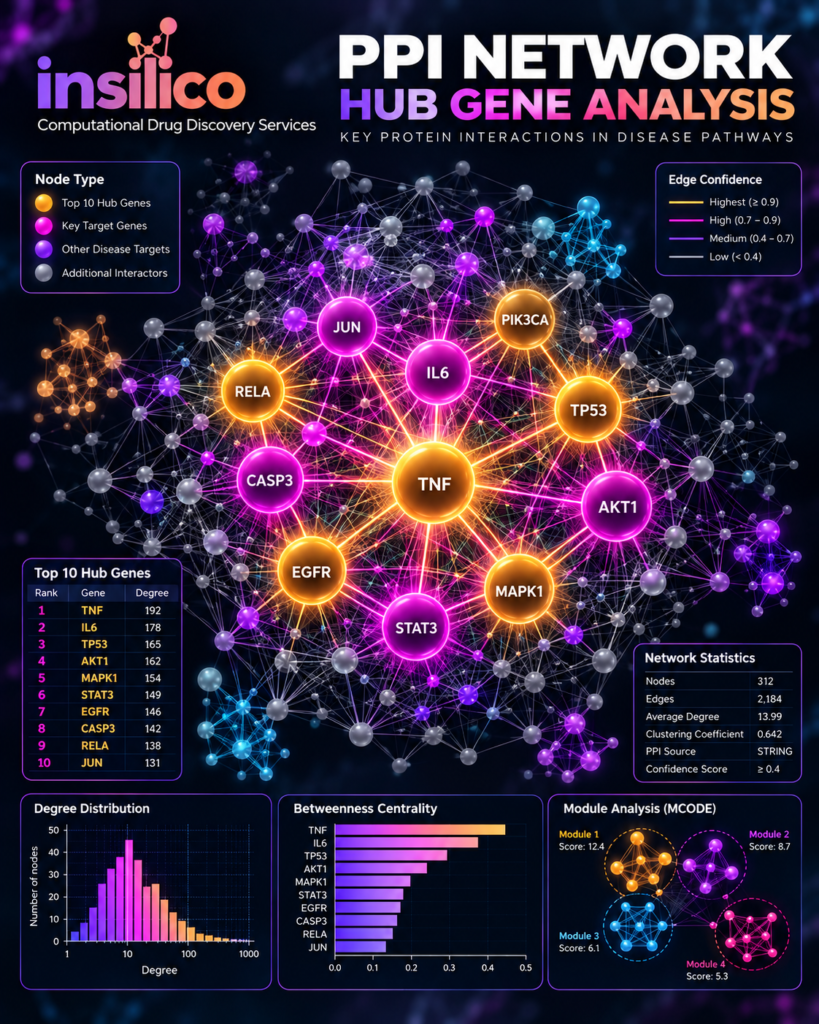
Network Pharmacology Workflow: From Compound Targets to Hub Genes and KEGG Pathways
Traditional drug-discovery models often focus on a simple relationship:
one compound → one target → one biological effect
Biological systems, however, are rarely that simple.
Diseases involve interconnected genes, proteins and signalling pathways, while many natural products and therapeutic compounds can interact with multiple molecular targets.
Network pharmacology provides a systems-level approach for investigating these complex relationships.
It has become particularly useful in natural-product research, drug repurposing and computational studies exploring potential mechanisms of action.
Step 1: Identify the Compounds
The workflow begins by defining the compounds being investigated.
Depending on the project, these may include:
- phytochemicals from medicinal plants,
- metabolites,
- approved drugs,
- experimental compounds, or
- compounds identified through literature or database searches.
Molecular identifiers such as canonical SMILES can then be obtained or prepared for computational analysis.
Step 2: Predict Compound Targets
The next step is identifying proteins that the compounds may potentially interact with.
Platforms such as SwissTargetPrediction can estimate possible molecular targets based on chemical similarity and known ligand–target relationships.
Where appropriate, researchers may combine predictions with information from curated chemical and pharmacological databases.
The result is a compound-associated target dataset.
Step 3: Collect Disease-Associated Targets
A separate dataset is created for the disease or biological condition of interest.
Common resources can include:
- GeneCards,
- DisGeNET,
- OMIM, and
- other disease–gene databases.
Care is required at this stage because databases use different evidence systems and scoring approaches. Disease-target collection should therefore be performed systematically rather than simply combining every available gene.
Step 4: Identify Overlapping Targets
Compound-associated targets are compared with disease-associated targets.
The intersection represents proteins that are both:
- potentially associated with the investigated compounds, and
- implicated in the disease.
A Venn diagram is often used to visualise this overlap.
These shared targets form the basis for subsequent network analysis.
Step 5: Construct a Protein–Protein Interaction Network
The overlapping targets can then be submitted to STRING to investigate known and predicted protein–protein relationships.
The resulting Protein–Protein Interaction (PPI) network contains:
Nodes → proteins
Edges → functional or physical associations between proteins
This network can then be imported into Cytoscape for further analysis and visualisation.
Step 6: Identify Hub Genes
Not every protein occupies the same position within a biological network.
Some nodes are more highly connected or structurally influential than others.
Cytoscape plugins such as cytoHubba can rank nodes using network-topology algorithms.
Common measures include:
- Degree,
- Maximum Clique Centrality (MCC),
- Betweenness,
- Closeness, and
- other centrality measures.
Proteins identified through these analyses are often referred to as hub genes or hub targets.
However, an important distinction should be made:
Network centrality does not automatically mean biological causality.
A highly connected protein may be important within the constructed network, but experimental evidence is still required to establish its actual role in a therapeutic mechanism.
Step 7: GO Enrichment Analysis
Gene Ontology analysis helps researchers understand the biological functions associated with the overlapping targets.
GO enrichment generally considers three categories:
Biological Process
The biological processes in which the genes participate.
Molecular Function
The molecular activities performed by gene products.
Cellular Component
The cellular locations or structures associated with those gene products.
Results can be visualised using bar plots or bubble plots to highlight significantly enriched terms.
Step 8: KEGG Pathway Enrichment
KEGG enrichment helps identify biological and signalling pathways associated with the target set.
Depending on the disease, enriched pathways may involve processes such as:
- inflammation,
- apoptosis,
- immune signalling,
- cell proliferation,
- oxidative stress, or
- metabolic regulation.
The interpretation should focus on pathways that are biologically relevant to both the disease and the investigated compounds rather than simply reporting the most statistically significant terms.
Step 9: Construct an Integrated Network
The analysis can then be expanded into a larger network connecting:
Compounds → Targets → Biological Pathways
This visualisation helps demonstrate the multi-component, multi-target and multi-pathway nature of the proposed mechanism.
For natural products containing several phytochemicals, these networks can be particularly informative.
Step 10: Integrate Molecular Docking
Network pharmacology identifies potentially important targets.
Molecular docking can subsequently investigate whether selected compounds can adopt plausible binding poses within those proteins.
For example:
Network pharmacology → identifies hub targets
Molecular docking → investigates compound–target interactions
ADMET analysis → evaluates predicted pharmacokinetic and toxicity characteristics
Together, these approaches provide multiple complementary layers of computational evidence.
A Critical Limitation
Network pharmacology is hypothesis-generating.
An attractive Cytoscape network does not prove that a compound treats a disease.
Target prediction, disease databases, PPI networks and pathway enrichment all contain assumptions and computational uncertainty.
Results should therefore be interpreted as potential molecular mechanisms that require experimental validation.
Final Thoughts
A well-designed network pharmacology study goes beyond producing colourful network diagrams.
Its purpose is to integrate chemical, genomic and biological information to develop testable hypotheses about how compounds may interact with complex disease systems.
Careful target collection, transparent filtering, appropriate network analysis and biologically informed pathway interpretation are therefore essential for producing meaningful results.
Planning a network pharmacology project?
InSilicoLogics provides compound-target prediction, disease-target analysis, STRING PPI networks, Cytoscape analysis, hub-gene identification, GO/KEGG enrichment and publication-ready network visualisations.