
SwissADME vs pkCSM vs ADMETlab: Which ADMET Tool Should You Use?
A compound can demonstrate promising activity against a biological target and still fail as a drug candidate because of poor absorption, rapid metabolism, toxicity or unsuitable pharmacokinetic properties.
For this reason, ADMET analysis — Absorption, Distribution, Metabolism, Excretion and Toxicity — is an important component of early-stage computational drug discovery.
Several freely accessible platforms can help researchers estimate these properties before experimental testing. Among the most frequently used are SwissADME, pkCSM and ADMETlab.
But which one should you use?
In many projects, the most useful answer is not necessarily one platform. Different tools provide complementary information.
1. SwissADME
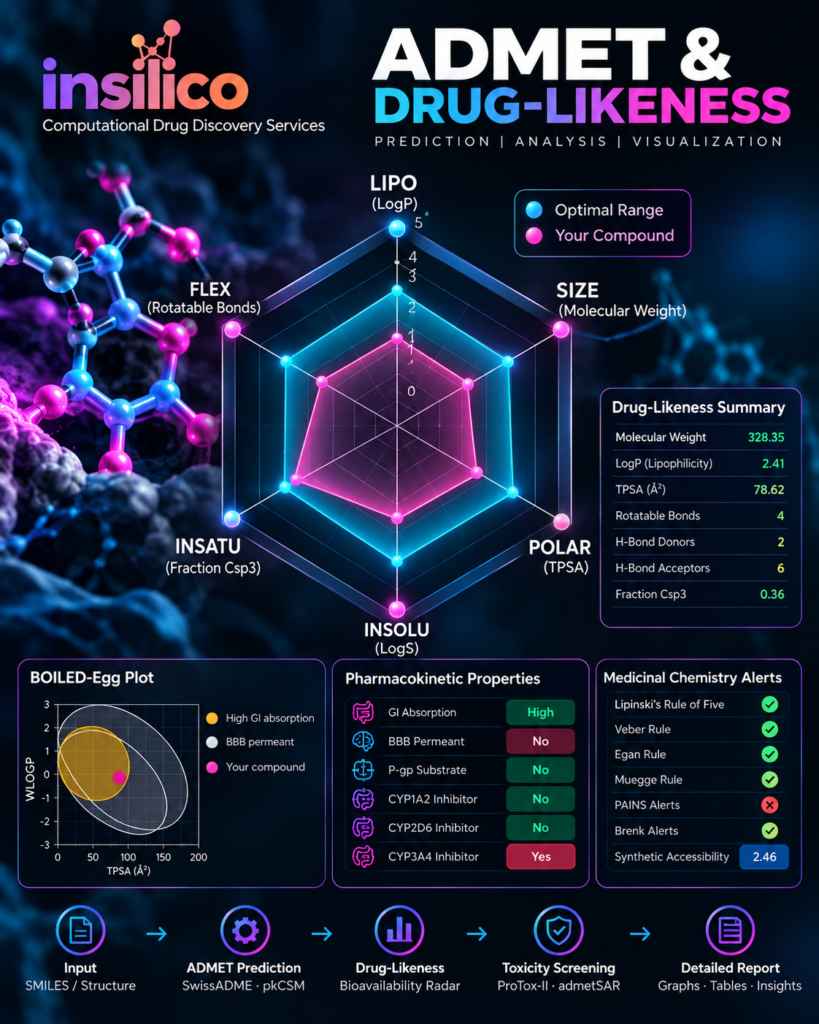
SwissADME is particularly useful for evaluating physicochemical properties, pharmacokinetic behaviour and drug-likeness.
Researchers commonly use it to examine parameters such as:
- molecular weight,
- lipophilicity,
- hydrogen-bond donors and acceptors,
- topological polar surface area,
- gastrointestinal absorption,
- blood–brain barrier-related predictions,
- P-glycoprotein interactions,
- cytochrome P450 inhibition,
- Lipinski’s Rule of Five, and
- other medicinal-chemistry and drug-likeness indicators.
One particularly useful feature is the BOILED-Egg model, which provides an intuitive visual representation of predicted gastrointestinal absorption and brain penetration.
SwissADME is therefore a strong starting point when screening compounds for general physicochemical and pharmacokinetic suitability.
2. pkCSM
pkCSM provides predictions across multiple pharmacokinetic and toxicity endpoints.
Depending on the compound and available model, researchers may investigate properties related to:
Absorption
- intestinal absorption,
- water solubility,
- skin permeability, and
- transporter-related behaviour.
Distribution
- volume of distribution,
- blood–brain barrier permeability, and
- central nervous system penetration.
Metabolism
- CYP enzyme substrate predictions, and
- CYP enzyme inhibition.
Excretion
- predicted clearance and
- transporter-associated properties.
Toxicity
- AMES-related predictions,
- hepatotoxicity-related endpoints,
- selected cardiac toxicity indicators, and
- additional computational toxicity estimates.
This broader coverage makes pkCSM useful when researchers want to extend screening beyond conventional drug-likeness properties.
3. ADMETlab
ADMETlab provides another comprehensive environment for computational ADMET evaluation.
It can be particularly useful when researchers want a broad panel of physicochemical, medicinal-chemistry, pharmacokinetic and toxicity predictions in a single analysis.
Depending on the platform version and available models, outputs can cover areas such as:
- physicochemical properties,
- absorption,
- distribution,
- metabolism,
- excretion,
- toxicity,
- medicinal chemistry, and
- drug-likeness.
Its broad prediction panel can complement results obtained from other ADMET platforms.
Should You Use Only One ADMET Platform?
Not necessarily.
Every computational prediction model has limitations. Different platforms may use different training datasets, molecular representations, algorithms and applicability domains.
Consequently, two tools can sometimes generate different predictions for the same compound.
Rather than automatically treating one result as correct and another as incorrect, researchers should examine why the predictions differ and consider the broader evidence.
A practical workflow might therefore combine:
SwissADME → physicochemical properties and drug-likeness
pkCSM → broader pharmacokinetic and toxicity screening
ADMETlab → complementary ADMET and medicinal-chemistry predictions
Additional specialised toxicity platforms may also be incorporated when a project requires investigation of specific endpoints.
How Should ADMET Results Be Interpreted?
A common mistake is to classify compounds simply as “good” or “bad” based on a single predicted parameter.
ADMET interpretation should instead consider the compound’s intended biological context.
For example, predicted blood–brain barrier penetration may be desirable for a compound intended to act within the central nervous system but unnecessary — or potentially undesirable — for a peripheral therapeutic target.
Similarly, one computational toxicity alert should not automatically be interpreted as proof that a compound is toxic.
These models generate predictions, not experimental confirmation.
Combining ADMET With Molecular Docking
Docking and ADMET answer different questions.
Molecular docking asks:
Can this compound adopt a plausible interaction with the selected target?
ADMET prediction asks:
Does this compound have computationally predicted properties compatible with further investigation?
A compound with an excellent docking score but problematic predicted pharmacokinetics may be less attractive for follow-up than a compound showing a balanced profile across several parameters.
This is why multi-parameter evaluation is generally more informative than selecting candidates based solely on binding affinity.
Final Thoughts
SwissADME, pkCSM and ADMETlab should not necessarily be viewed as competing platforms.
Each provides a different computational perspective on compound behaviour.
Used carefully, these tools can help researchers prioritise compounds, identify potential liabilities and generate hypotheses before committing resources to experimental testing.
The key is not simply generating a large table of predictions — it is understanding what those predictions mean within the biological and pharmacological context of the research question.
Need ADMET and toxicity analysis for your compounds?
InSilicoLogics provides structured ADMET screening, toxicity prediction, comparative compound analysis and publication-ready figures for computational drug-discovery projects.